1 The Evolution of PASS Over Two Decades
Contact authors: Chauhan, Madhu; Trappmann, Mark; Wenzig, Claudia.
The Institute for Employment Research (IAB) launched the Panel Study Labour Market and Social Security (PASS) in 2006 to address critical research gaps in the analysis of the labour market, the welfare state, and poverty in Germany. PASS is particularly rooted in research on Social Code Book II (SGB II) and examines the effects of active labour market policies as well as income support.
At the core of the study are five key research questions:
What pathways lead out of Unemployment Benefit II1 receipt?
How do the social and financial situations of affected households change while receiving benefits?
What coping strategies do affected individuals develop, and how do their orientations and behaviours evolve?
How do interactions with agencies providing the benefits take place, and what do these institutional practices look like?
What employment trajectories and household dynamics contribute to long-term benefit dependency?
These five guiding questions provide a structured framework for the development of the survey (Achatz et al., 2007) and ensure that the collected data allows for both cross-sectional and longitudinal analyses.
1.1 PASS background and objectives
From its inception, the PASS design made it possible to link PASS data with administrative records, enabling in-depth longitudinal analyses of employment trajectories (see Section 5.4). In several respects, PASS extends and compliments existing administrative data from the Federal Employment Agency (BA) and representative surveys such as the Socio-Economic Panel (SOEP), which provide valuable insights into the evaluation of SGB II.
Specifically, PASS extends the scope of administrative data by incorporating household dynamics before and after the receipt of Unemployment Benefit II (UB II) and encompassing all relevant population groups, including self-employed individuals and those marginally attached to the labour market, in addition to employed, unemployed, and welfare recipients. Moreover, the survey captures labour market-related attitudes and behaviours, offering a more comprehensive perspective on social security dynamics. Compared to existing panel surveys, the higher number of cases involving basic income recipients and low-income groups further strengthens the dataset, improving its capacity for detailed analyses such as assessing the impact of SGB II on specific target groups, including migrants, single parents, and supplemental benefit recipients (“Aufstocker”), thus enhancing the precision of statistical estimates and model coefficients.
However, the scope of PASS extends far beyond the evaluation of SGB II. The survey is representative of both benefit recipients and the general population, providing a comparative perspective that distinguishes between the experiences of social security benefit recipients and non-recipients. Furthermore, PASS covers broader socio-economic themes such as labour market participation, social inclusion, digitalisation, and other relevant changes of socio-economic conditions.
With 18 complete survey waves to date, PASS stands as one of Germany’s most significant long-term studies on social security and labour market policy. Both its survey design and questionnaire content have evolved over time to reflect major societal changes, such as the refugee influx (2014–2015, 2022), the COVID-19 pandemic, and the introduction of the Citizen’s Benefit (Bürgergeld) in 2023, to name a few.
PASS data provides valuable insights for both scientific research and policy advice. Researchers and policy-makers benefit from the panel’s longitudinal structure, which enables tracking individual changes over time. Researchers can analyse transitions between employment and unemployment, explore poverty and household composition, and examine institutional experiences. The dataset offers a robust empirical foundation for evaluating the impact of welfare policies and supporting informed political decision-making.
The following table summarises major questionnaire-related and methodological innovations across PASS waves.
| Year | Wave | Questionnaire related | Methodology related |
|---|---|---|---|
| Waves 1–5: Initial data collection and first extensions focusing on labour market participation, social benefit receipt, household structure, and social situation. | |||
| 2006/07 | 1 | Initial data collection focusing on labour market participation, social benefit receipt, household structure, and social situation. | |
| 2007/08 | 2 | Initial design of a more detailed survey on employment histories focusing on episodes (employment, unemployment, labour market-related activities). |
Integration of new SGB II entrant samples. No longer an English-language survey version. |
| 2008/09 | 3 | Development and integration of focus modules on health and social networks (distinct from basic modules). | Introduction of dependent interviewing. |
| 2010 | 4 | Revision and finalisation of the employment episodes survey (biography module). | Data preparation: Design of cross-wave harmonisation for the biography module. |
| 2011 | 5 | Replenishment samples to improve panel stability and representativeness. | |
| Waves 6–9: Expansion of thematic modules, particularly on job quality, childcare, health, and methodological refinements in data and fieldwork. | |||
| 2012 | 6 | More detailed data collection on childcare and children’s social participation. |
Data preparation: Introduction of a child dataset. Fieldwork: Introduction of adaptive design: Three field phases with different control and incentive strategies. |
| 2013 | 7 | Refinements and add-ons in the employment biography module. | Increased use of preload information to reduce inconsistencies. |
| 2014 | 8 | Revision of the module on interactions with job centres. | |
| 2015 | 9 |
Introduction of an improved module for surveying social networks and social support. Modification of the health module with more detailed questions on mental and physical health. |
|
| Waves 10–17: Adaptation to current societal developments such as refugees, digitalisation, the COVID-19 pandemic, and the Citizen’s Income reform. | |||
| 2016 | 10 |
Addition of migration-related questions, particularly focusing on refugees. Addition of child specific deprivation items. |
Expansion of the sample to include Syrian/Iraqi refugees within SGB II. Arabic added as a survey language; Turkish discontinued. |
| 2017 | 11 | Introduction of specific modules on digitalisation and new forms of work. | |
| 2018 | 12 | Addition of questions on retirement planning and financial security. | |
| 2019 | 13 | Introduction of a module on political participation. | |
| 2020 | 14 | Addition of questions concerning the pandemic added into the ongoing fieldwork. |
Modified fieldwork during the COVID-19 pandemic: No on-site CAPI interviews, increased share of telephone interviews (CATI), and extended field periods. Implementation of additional CAPI-interviewer monitoring system for quality control. Refinement of adaptive survey design for fieldwork management. |
| 2021 | 15 |
Expanded questions on psychological stress during the COVID-19 pandemic. Introduction of a module on household practices to cope with financial strain. |
Fieldwork: Continued absence of on-site CAPI interviews. Oversampling of the Syrian/Iraqi newcomer sample. Oversampling of self-employed recipients entering welfare benefits during the pandemic. |
| 2022 | 16 | Extended questions on internet usage. |
Fieldwork: Resumption of CAPI fieldwork. Oversampling of the Syrian/Iraqi newcomer sample. Methodological experiment on gender-neutral phrasing. First PASS web survey. |
| 2023 | 17 | Additional questions on the introduction of Citizen’s Income, including stigma awareness, interactions with job centres, and further training opportunities. |
Expansion of the sample to include Ukrainian refugees within SGB II. New Ukrainian-language survey version. Replenishment samples. |
| 2024 | 18 | Second PASS web survey. | |
Timeline of major changes in questionnaire and methodological innovations introduced across PASS waves.
Table 1.1 outlines the key milestones in the development of PASS which are discussed in detail in the following sections.
1.2 Development of Focal Issues Over the Waves
In its initial years, the survey primarily focused on fundamental aspects of social security and labour market integration. The first five waves systematically captured employment trajectories, household composition, benefit receipt, and socio-economic conditions. Additionally, from wave 3 onwards, the survey incorporated initial modules on health and social networks.
As the survey evolved, its thematic scope gradually expanded. Between waves 6 and 10, the survey extended its coverage of employment biographies. Episode-based questions fostered precise tracking of job changes, unemployment durations, and other labour market-related activities in a structured manner. During this period, family-related topics drew attention. For instance, wave 6 introduced a child module to examine social inclusion and educational participation and childcare arrangements within households.
In later waves, the survey focused on contemporary societal developments. Starting from wave 10, the survey introduced an expanded version of migration related questions to better capture the situation of refugees in Germany. In wave 11, the survey incorporated questions on the digital working environment, capturing topics such as remote work, and evolving forms of employment.
The outbreak of the COVID-19 pandemic in 2020 marked a significant thematic shift for the survey. The pandemic not only affected social life and labour market conditions, which led to content-related adjustments in the questionnaire, but also disrupted data collection methods. In response to the crisis, wave 14 introduced a dedicated module examining the effects of pandemic on the labour market. Key topics included short-time work, job loss, and the increased use of remote work, alongside changes in income due to pandemic. Additional questions explored childcare challenges due to school and day-care closures during pandemic. Mental health also became a key area of inquiry, prompting an extension of the health module to include items on anxiety, stress, and emotional exhaustion (see Section 4.3.2).
The introduction of the Citizen’s Benefit (Bürgergeld) in 2023 (wave 17) led to further adjustments in the survey content, as the switch from “Unemployment Benefit II” to “Citizen’s Benefit” involved substantial legal framework and policy changes beyond the re-labelling of a policy. Accordingly, the survey incorporated questions about changes in job centre services and support measures. A new module focused on questions regarding promotion of training and qualification measures was introduced, since the updated legal framework aims to enhance the integration of long-term unemployed individuals into the labour market. The survey also provides the possibility to examine the subjective perception of stigmatisation associated with receiving Citizen’s Benefit.
These developments illustrate how PASS continuously realigns its focus in response to changing social and policy landscapes. While some modules, such as employment biographies, job quality, health, and agency contacts, have remained central, the survey has also incorporated several temporary modules, such as the evaluation of the Educational Package or the COVID-19 module (further details on survey instruments see Chapter 4). At the same time, topics that proved less relevant over time, such as crowd-working or pension provision, have been removed from the questionnaire. This ongoing revision ensures the survey remains aligned with current scientific, academic and policy priorities.
Alongside content-related expansions, PASS has implemented numerous methodological advancements over the years to enhance data quality and ensure representativeness. The most significant methodological innovations are outlined in the following section.
1.3 Methodological Innovations to Improve Data Quality
To maintain representativeness over time and counteract panel attrition, PASS has incorporated an annual refreshment sample of new SGB II entrants from the beginning. This approach allows the survey to include new households while ensuring continued and accurate representation of the SGB II recipient population. In addition to these annual refreshment samples, periodic replenishment samples are included in both the SGB II and general population samples (further details in Chapter 2). The survey also introduced targeted refugee samples i.e., Syrian and Iraqi refugees in wave 10, and Ukrainian refugees in wave 17 (see Section 6.1). These inclusions were in response to changing societal dynamics and the evolving composition of the SGB II population. To effectively include these groups, PASS expanded its language offerings. It introduced an Arabic-language version in wave 10 and a Ukrainian-language version in wave 17.
Another key methodological improvement is the shift to an episode-based recording of employment biographies. While the first wave only documented respondents’ current employment status, the revised survey methodology enables a comprehensive tracking of employment, unemployment, and other labour market-relevant episodes. This substantially improved the data foundation for analysing employment instability and transitions between different forms of work. The introduction of “Dependent interviewing” from wave 3 has further enhanced data quality by allowing respondents’ previous answers to be incorporated into the current interview, reducing inconsistencies and minimising cognitive burden.
A major methodological shift occurred during the COVID-19 pandemic (see Section 6.4 and Sakshaug et al. (2020)). Since in-person interviews were not feasible during lockdown, the survey largely replaced computer-assisted personal interviewing (CAPI) with computer-assisted telephone interviewing (CATI) from wave 14 onwards. The surveys returned to pre-pandemic survey methods in wave 17. To minimise distortions caused by the change in methodology, the team conducted rigorous statistical consistency analyses, thus ensuring that the data remained comparable across wave 14 to wave 17.
PASS also employs innovative methods in fieldwork to continuously improve data collection quality. Since wave 6, the field time has been divided into three phases to maximise response rates. Initially introduced as an experiment, an adaptive survey design approach was systematically implemented in later waves (see Section 6.3 and Beste et al. (2023)). This method uses information from previous waves to identify hard-to-survey respondents and tailor incentive strategies accordingly.
From wave 14 onwards, PASS introduced new statistical procedures to enhance data quality (see Section 6.5 and Beste et al. (2021)). Longitudinal consistency checks ensure the coherence of responses across waves, while time stamp analyses help detect irregularities in interview conduct, by identifying unusually short or long interview durations. These quality control mechanisms further optimised data reliability and ensured comparability across survey waves.
Managing a high participation rate and minimising panel attrition remain key challenges for the survey. Therefore, in wave 16, PASS conducted its first web-based survey as a supplement to the main survey, including additional question modules. Another web survey followed in wave 18. These methodological experiments aim to explore whether a web survey mode, alongside CATI and CAPI, could help improve panel stability and counter rising costs, particularly in CAPI fieldwork (see Section 6.2).
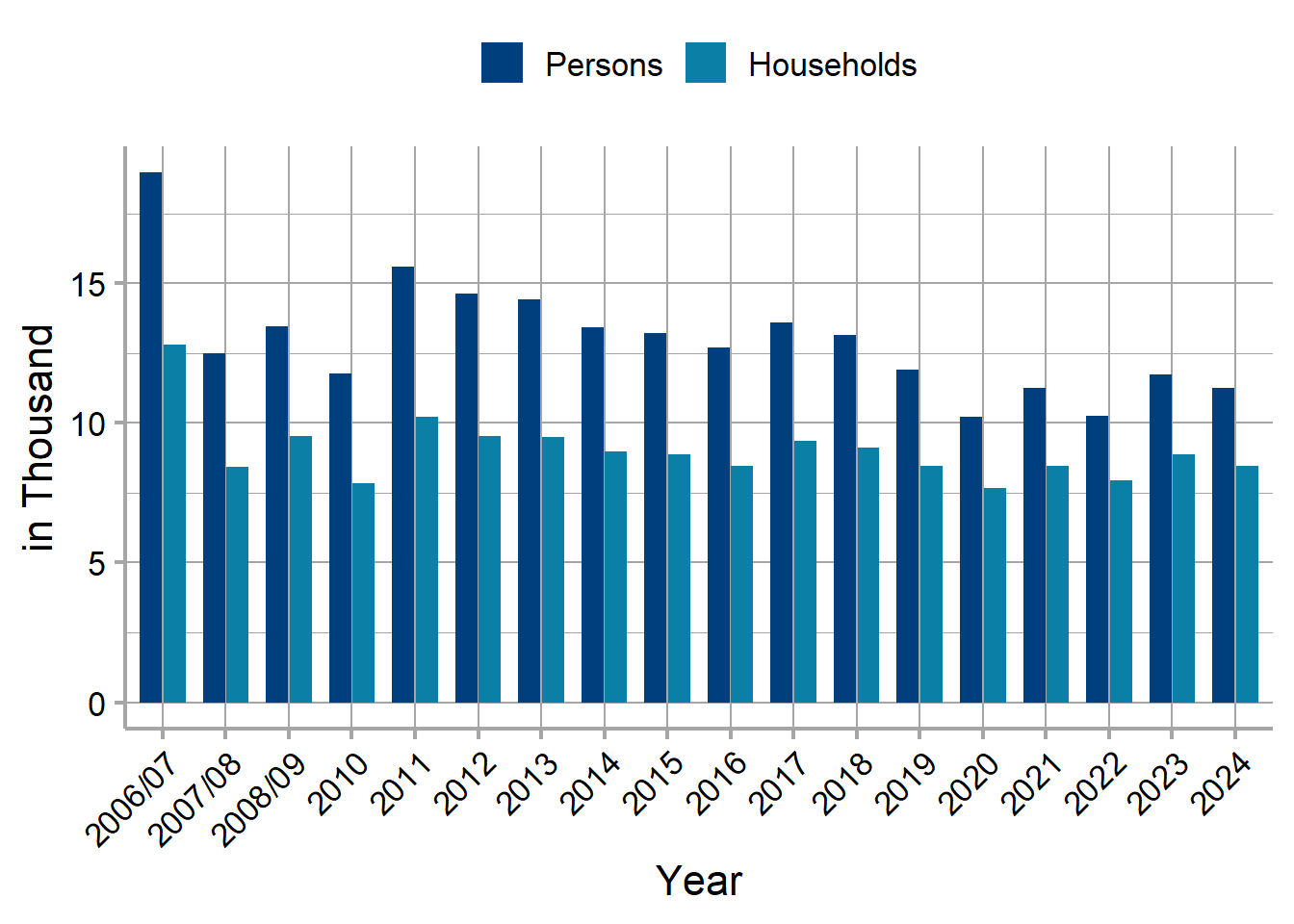
Figure 1.1: Persons and households interviewed in PASS in each survey year (in thousand). Source: Data Report IAB.
Finally, Figure 1.1 presents wave specific numbers of individuals and households interviewed in PASS over the years.
Over the past two decades, PASS has continuously evolved both in content and methodology to serve as a reliable data source for research and policy advice. The ambition to remain indispensable in the future drives the ongoing integration of new topics and innovative methods, enabling PASS to respond flexibly and appropriately to societal changes.